Long-haul economy seats weren’t designed for human anatomy. Hours of upright sitting on a thin layer of foam, leaning slightly forward into a seatback that doesn’t quite meet your spine, leaves most travelers stiff, numb, and counting the minutes until landing. A well-chosen cushion solves the seat, not the person, and that’s the goal here: a layer of support that fits in a carry-on, survives the overhead bin, and gives you something softer to sit on for nine hours to Dubai.
A Snapshot Of The Selections

Press-Inflate Airplane Seat Cushion 36-Bag

AUVON Ventilation Seat Cushion with Memory Foam
Upgrade Airplane Seat Cushion with Built-In Pump

Sleepavo Office Chair Cushion for Tailbone

Purple Back Cushion Lumbar Support Pillow
Purple Ultimate Seat Cushion 2.5-Inch Large

Purple Double Seat Cushion Two-Sided

Purple Royal Seat Cushion with GelFlex Grid

Purple Simply Seat Cushion 1.25-Inch Low-Profile

GRAND PITSTOP Gel Memory Foam Seat Cushion
A Breakdown Of The Leading Choices
This first pick takes a different angle from the foam-and-fabric crowd. Instead of foam, you get a 36-bag inflatable pad that deflates flat, slips into a carry-on, and inflates on demand with a built-in press pump. No external pump, no mouthpiece, no huffing and puffing in the boarding area.
The bag-grid construction is built to spread weight across more contact points, so the load under your sit bones and tailbone feels lighter than a flat air mattress would. Travelers who bounce between flights, trains, and stadium seats get one tool that adapts to all three.
Useful Highlights
- Built-in press inflation means no extra pump to pack or forget at the hotel.
- 36 individual air bags create a segmented surface that flexes with your posture.
- Deflates flat to roughly the size of a folded jacket for overhead-bin storage.
- Multi-surface design covers airplane, office, car, and stadium seating.
Points To Note
- Air cushions need reinflation between long sessions, so expect a quick top-up after a few hours.
- The press-pump valve can take 40-plus pumps to fill, which is fine on a hotel bed but not ideal in a cramped row.
- Inflatable pads can develop slow leaks over years of use, so pack a small patch kit for heavy travelers.
Quick Facts
Made For
Travelers who want maximum packability and don’t mind spending a minute inflating before takeoff.
Consider Something Else When
You want a set-it-and-forget-it foam seat, in which case the Sleepavo Office Chair Cushion delivers firmer support out of the box.
Where most memory foam cushions trap heat, this AUVON model leans into airflow. A pattern of 30 ventilation holes and 11 grooved channels runs through the foam, giving warm air somewhere to escape on a six-hour flight or a summer stadium seat.
The foam itself is dense enough to keep its shape under sustained use but soft enough at the surface to cradle sit bones. A waterproof, anti-slip cover handles spilled drinks and the gradual slide that happens when an economy seat tilts back. Travelers who run hot, especially on long-haul flights, will feel the difference in the first hour.
What Pays Off
- 30 air holes plus 11 grooves move heat away from the body during long sits.
- Memory foam contours to your shape, then recovers for the next session.
- Waterproof cover wipes clean after a coffee spill or sweaty commute.
- Anti-slip base keeps the cushion anchored during turbulence or recline.
Some Limits To Know
- The X-Large footprint may overhang narrower economy seats by an inch or two.
- Memory foam holds body heat longer than mesh or inflatable designs.
Whose Shelf It Belongs On
Hot-natured travelers and anyone who has stood up from a flight with a damp back will appreciate the airflow channels most.
Not Your Match When
You want the lightest possible cushion for backpacking, where the SGJHUI Upgrade Airplane Seat Cushion deflates smaller.
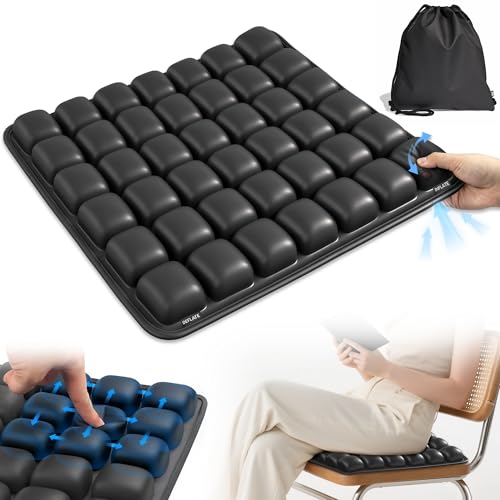
If the first pick’s air-bag grid sounds appealing but the inflation count sounds like work, this SGJHUI model trims the friction. A redesigned valve opens with repeated presses, fills in fewer cycles, and folds into a compact storage bag once you’re back on the ground.
The non-skid base keeps the cushion from sliding forward when the seat in front reclines, and the release valve lets you adjust firmness without deflating completely. For one-bag travelers who count every inch of pack space, this lives somewhere between the press-pump design and a traditional foam cushion.
Everyday Wins
- Improved valve design reduces pump count compared to older inflatable cushions.
- Folds into the included storage bag for tight packing.
- Non-skid bottom fights the slide on reclining airline seats.
- Adjustable firmness through a separate release valve.
Worth Noting
- Still requires manual inflation, just less of it than the original press-pump design.
- Inflatable cushions can feel bouncy to travelers expecting foam-firm support.
Best Suited To
One-bag travelers who want something lighter than memory foam but sturdier than a flat air pillow.
A Better Fit Elsewhere
You want zero setup at all, in which case the GRAND PITSTOP Gel Memory Foam Seat Cushion comes ready to sit on.
The Sleepavo cushion leans on shape rather than thickness. A U-shaped cutout runs through the rear of the seat, leaving the tailbone suspended instead of pressed against hard foam. For travelers with a sensitive coccyx (the small triangular bone at the base of the spine), that one design choice often matters more than material density.
The contoured surface promotes a slight forward pelvic tilt, which keeps the lumbar curve from collapsing during a long sit. Outside the cabin, it doubles as an office chair upgrade, so the same cushion handles your desk and your flight. It feels less like a luxury item and more like an orthopedic tool that happens to travel well.
What Earns Its Place
- U-shaped cutout removes direct pressure from the tailbone.
- Contoured shape encourages a neutral pelvic position during long sits.
- Works equally well in a plane seat or an office chair.
- Foam density supports body weight without flattening permanently.
Potential Drawbacks
- Foam body still traps heat compared to ventilated or inflatable designs.
- Standard density may feel firm to anyone used to a softer plush surface.
Who Should Grab It
Travelers managing tailbone discomfort or anyone who finishes flights with lower-back stiffness that foam density alone won’t fix.
Look Elsewhere When
You need cooling airflow during summer flights, where the AUVON Ventilation Seat Cushion is a more breathable choice.
Most cushions on this list sit under you. This Purple model sits behind you. The lumbar support pillow uses the same GelFlex Grid (a polymer lattice that collapses under pressure while keeping air channels open) that defines Purple’s seat cushions, molded to the curve of the lower back rather than the seat pan.
An adjustable strap and buckle lock it to most office chairs, gaming chairs, and car seats, and the stretch cover uses a polyester-spandex blend that flexes with the grid. For travelers who pair it with one of Purple’s seat cushions, the back support fills the gap that a seat-only cushion leaves untouched.
Reasons It Performs
- GelFlex Grid conforms to the lumbar curve without flattening out.
- Strap-and-buckle system fits most seat backs securely.
- Polyester-spandex cover stretches with the grid for even support.
- Functions as a standalone office chair upgrade or flight companion.
Trade Offs
- Addresses lumbar support only; you’ll need a separate seat cushion for sit-bone relief.
- Strap length may not fit every airline seatback, depending on thickness.
Right Fit For
Travelers who finish flights with mid-back tightness rather than tailbone pain, and who already own or plan to buy a seat cushion separately.
Skip It When
You want an all-in-one solution, where the Purple Royal Seat Cushion combines seat and support in a single portable pad.
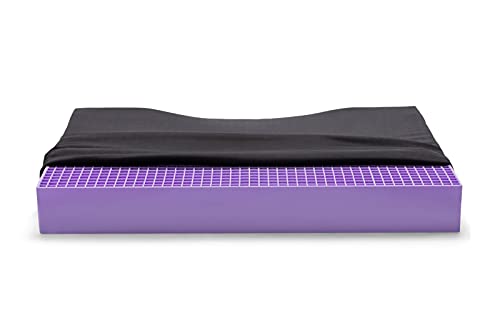
This is Purple’s thickest seat cushion and the largest footprint in the lineup. At 21.75 by 18 inches with a 2.5-inch profile, it covers the full base of a wider airline seat, gaming chair, or office chair with room to spare. For travelers with broader frames or anyone who feels pinched by standard-size cushions, that extra coverage matters.
The GelFlex Grid still does the heavy lifting: collapsing under sit bones and tailbone while staying open around the edges for airflow. The thicker grid stack means deeper pressure relief during long sessions, though it also adds weight and bulk that smaller travelers may not need.
Benefits That Matter
- 2.5-inch thickness delivers deeper cradle for heavy or tall users.
- Large 21.75 by 18-inch footprint fits wider office and airline seats.
- GelFlex Grid collapses under load while keeping airflow channels open.
- Polyester-spandex cover wipes clean and flexes with the grid.
Points To Keep In Mind
- Larger size may extend past narrow economy seat pans.
- Added thickness raises seat height by more than two inches, which can affect knee angle on shorter travelers.
Who Will Love This
Taller or broader travelers with wider seats who want maximum pressure relief and have room to spare in their carry-on.
Reach For A Different Pick When
You fly basic economy with tight seat pitches, in which case the slimmer Purple Simply Seat Cushion at 1.25 inches fits where this one won’t.
Most cushions lock you into one feel. The Purple Double flips the script, literally. Two grid layers stack inside the cover; flip the cushion and you switch from a softer small-grid surface to a firmer large-grid surface. Travelers who bounce between short hops and long-haul flights can tune the cushion to the trip.
The 2-inch total thickness splits the difference between Purple’s slimmest and thickest models, so it works on most airline seats without raising your knees too high. The same polyester-spandex cover wraps both sides, keeping the package portable for cabin or hotel use.
Why It Works Well
- Two surfaces in one cushion let you choose soft or firm per trip.
- 2-inch thickness fits most airline seats without raising knees excessively.
- GelFlex Grid on both sides keeps airflow moving through the cushion.
- Polyester-spandex cover handles either orientation.
Things To Weigh
- Two-sided design adds a touch more weight than single-layer Purple models.
- Flipping mid-flight requires standing up, so commit to a side before takeoff.
Perfect Match For
Travelers who want one cushion that adjusts between short commuter flights and longer international trips.
Swap It Out When
You always want the same feel and the lowest profile, where the Purple Simply Seat Cushion stays fixed at 1.25 inches.
Where some travel cushions feel like an afterthought, the Purple Royal is built for the road. Built-in handles let you grab and go from car to gate to stadium seat, and at 17.5 by 15.75 inches with a 2-inch profile, it slides into a personal-item bag without forcing a repack.
The GelFlex Grid cradles the tailbone the same way other Purple models do, but the addition of handles makes it a more obvious travel companion. Six pounds is not light, but for travelers moving between cars, trains, and planes, the trade-off feels reasonable.
Well-Handled Touches
- Built-in handles simplify the carry from security to gate to seat.
- 2-inch GelFlex Grid balances pressure relief with a portable footprint.
- 17.5 by 15.75-inch dimensions fit standard airline seat pans.
- Polyester-spandex cover cleans up after stadium snacks or car commutes.
Honest Caveats
- Six pounds is heavier than inflatable or thin-foam alternatives.
- Single-side feel limits flexibility compared to the Purple Double’s two-sided design.
Technical Sheet
Who It Suits Best
Travelers juggling multiple seats in a single day: car to airport to plane to hotel to stadium.
Where A Sibling Pick Shines
You want the same grid feel at half the weight, where the Purple Simply Seat Cushion at 4 pounds fits lighter carry-on setups.
Tight economy seats don’t have room for a 2.5-inch cushion, and basic-economy travelers know it. The Purple Simply trims the grid stack to 1.25 inches and the weight to 4 pounds, so it slips under you without forcing your knees up or your carry-on over the limit.
You’re trading pressure relief for portability here, and that’s the right call for travelers who fly short-haul or premium economy with adequate seat depth. The GelFlex Grid still collapses under sit bones, and the breathable cover keeps airflow moving even with the slimmer profile.
Strengths Worth Knowing
- 1.25-inch profile fits tighter airline seat pitches without raising knees.
- 4-pound weight keeps it inside carry-on limits easily.
- GelFlex Grid core delivers familiar Purple pressure relief in a thinner package.
- Breathable cover handles long sits without trapping heat.
Things To Consider
- Thinner grid stack means less depth under sit bones than the Purple Ultimate.
- Low profile may feel minimal to travelers used to thicker memory foam.
Right Fit For
Basic-economy flyers and short-haul travelers who need a slim, light cushion that doesn’t push their knees toward the seatback.
Consider Something Else When
You want deeper cradling for a long-haul flight, where the Purple Ultimate Seat Cushion adds another inch of grid for sustained relief.
The final pick blends two cushion philosophies into one pad. A high-density gel-infused memory foam core holds its shape across long sits, while the gel beads work to move heat away from the body. The result feels more substantial than pure memory foam but cooler than dense foam alone.
GRAND PITSTOP frames the design as orthopedic, with a U-shaped contour aimed at supporting the spine, tailbone, hips, and lower back. Travelers who split time between an office chair, a car seat, and an airline seat get one cushion that adapts to all three without inflation or flipping.
Standout Benefits
- Gel-infused memory foam hybrid balances contour with airflow.
- U-shaped ergonomic design supports tailbone, hips, and lumbar curve.
- Multi-surface versatility covers office, car, home, and travel.
- Foam density holds its shape across daily use.
Less Ideal Details
- Memory foam body still runs warmer than mesh or inflatable designs in hot cabins.
- Orthopedic shape may feel too structured for travelers wanting a plush sit.
Built With In Mind
Travelers who want a single foam cushion for office and flight use without learning how to inflate or flip anything.
Another Choice May Suit
You need maximum airflow during summer travel, where the AUVON Ventilation Seat Cushion runs cooler through dedicated channels.
What To Weigh Before Choosing Your Airline Seat Cushion
Matching a cushion to your flight style matters more than chasing the thickest pad on the shelf. Economy travelers with tight seat pitches need a low-profile design that won’t push their knees upward. Travelers flying premium or with wider seats can take advantage of larger footprints and deeper grids. If you run hot, ventilated or inflatable cushions handle cabin warmth better than dense foam, while tailbone-sensitive travelers benefit most from a U-shaped cutout that removes pressure from the coccyx.
Storage and weight are the practical constraints most shoppers underestimate. An inflatable cushion deflates flat and disappears into a carry-on, but it requires inflation and may need a top-up on long flights. A foam cushion needs no setup, but it adds bulk and weight to your bag from day one. Frequent commuters tend to favor thin foam or low-profile gel designs, while occasional long-haul travelers often prefer an inflatable that packs flat between trips.
Build quality varies more than material labels suggest. The GelFlex Grid used across Purple’s lineup collapses under load while keeping air channels open, which is why four of these picks share the same core technology. Generic inflatable pads use similar engineering principles, but the press-pump mechanism and valve sealing determine whether the cushion holds air reliably across dozens of flights. Look for established return policies if you’re buying a generic inflatable for the first time.
Matching the cushion to your body matters more than matching it to the seat. Broader travelers usually want larger footprints with deeper grids; smaller travelers often do better with slimmer profiles that fit narrower seat pans. If you finish flights with mid-back tightness rather than sit-bone soreness, pair a seat cushion with the Purple Back Cushion for full lumbar coverage.
Key Considerations Across These Picks
Pitfalls Shoppers Hit
Buying the thickest cushion on the shelf feels logical, but thicker isn’t always better in economy class. A 2.5-inch pad raises your knees toward the seatback and forces you to perch rather than sit. Measure your seat pitch (the distance between your seatback and the seat in front of you), or at least estimate it, before choosing a profile. Skipping the cover material is the other common miss: a non-breathable polyester cover traps heat on long flights, while a waterproof or anti-slip base handles spills and turbulence. Choose based on your likely conditions, not just the foam inside.
Where The Extra Money Goes
The jump from a generic inflatable to a Purple gel cushion isn’t just branding. GelFlex Grid construction resists permanent compression far longer than standard foam, so the cushion keeps its shape across years of daily office or flight use. Memory foam with gel infusion costs more because the gel beads add cooling and density control that pure foam can’t match. Higher-tier cushions also tend to use better cover fabrics, stronger zippers, and reinforced stitching, which show up after the second year of regular travel, not in the first week. Pay more when you need a cushion that survives daily use; save when you fly a few times a year.
Frequently Asked Questions
Do inflatable seat cushions hold air on long flights? Most press-pump models hold air reliably for a full long-haul flight, though you may notice a slight softness after 6 to 8 hours. A quick top-up with the built-in pump restores firmness in under a minute.
Can I use a memory foam cushion on a basic-economy seat? It depends on the cushion’s thickness. Anything over 2 inches will push your knees up on tight seat pitches. Look for a low-profile foam or gel design around 1.25 inches if you’re flying basic economy regularly.
Will a seat cushion help with lower-back pain during flights? A seat cushion addresses sit-bone and tailbone pressure, which often contributes to lower-back tightness. For direct lumbar support, pairing a seat cushion with a back support pillow covers both regions more completely.
Are gel cushions cooler than memory foam? Gel-infused foam and GelFlex Grid designs move heat away from the body better than standard memory foam, but they still trap some warmth. Ventilated designs with air channels or inflatable cushions run coolest overall.
How do I clean a travel seat cushion? Most covers unzip for machine washing on a gentle cycle. For foam cores without removable covers, spot cleaning with a mild detergent and air drying works best. Avoid soaking foam, since moisture trapped inside can lead to mildew over time.
Closing Remarks
The right cushion turns a long flight from something you endure into something you tolerate. Match the profile to your seat pitch, the material to your body temperature, and the footprint to the way you actually travel, whether that’s a daily commute or a yearly transatlantic hop. Start with one of these ten and your next flight will feel noticeably shorter.