You spend a long Saturday on a ridgeline, your phone dies at 11 a.m., and the only outlet is fifty miles behind you. Backpack solar chargers exist for exactly that moment, turning a hiking pack or a portable panel into a quiet generator. The trick is matching the format to your trip: an all-in-one bag for commuters, a fold-out panel for thru-hikers, or a solar power bank for emergencies. This list sorts through ten popular options so you can pick the right tool for the miles ahead.
A Side-By-Side Look

Outdoor Tech Mountaineer Solar Backpack 40L

MHPOWOS 40W Portable Solar Panel Charger

BigBlue Solar Power Bank 20,000mAh

TOZLU 5V 14W Solar Panel Laptop Bag

SOARAISE 48000mAh Solar Power Bank
SOARAISE 48000mAh Wireless Battery Pack

Solar Power Bank 48000mAh with 4 Cables

SolarGoPack Solar Powered Backpack (Yellow)
Voltaic Systems Converter Solar Backpack Charger
Goal Zero Nomad 10 Solar Panel
Meet The Standout Selections
The Mountaineer is built for hikers who want a real pack first and a solar charger second. A 40L capacity swallows weekend layers, and the 6.5W panel detaches when you want to angle it toward the sun without rotating the whole bag.
Unlike the MHPOWOS panel that comes later, this one is integrated into a full backpack system. Most day hikers and overnight backpackers will find the form factor more useful than a loose panel they have to clip on.
A Favorable Mix
- Detachable 6.5W flexible panel lets you angle it independently from the bag
- 40L capacity fits multi-day loads, not just phone-and-wallet runs
- Rugged outdoor construction handles trail abrasion and weather
- Panel can top up a phone or small battery pack during long breaks
Worth Noting
- 6.5W output is modest compared with the 40W MHPOWOS panel below
- Heavier than carrying a clip-on panel plus a separate daypack
- Owners commonly report the panel needs direct midday sun for meaningful charge rates
Who Will Love This
Multi-day backpackers and campers who want one bag that carries everything and tops off a phone along the way.
Skip It When
The MHPOWOS 40W panel suits you better when you run power-hungry gear like camera batteries and need faster off-grid charging.
When raw wattage matters more than built-in bag space, the MHPOWOS 40W panel delivers. Three output ports cover USB-C, USB-A, and a DC barrel, so a wider range of gear pulls power from one source.
The folded footprint of roughly 12.5 by 8.8 inches slides into a pack, and two included carabiners clip it to the outside of any bag. Compare that to the Mountaineer above, and the trade-off shows up immediately: more power, but you bring your own backpack.
Where It Delivers
- 40W output significantly outpaces the 6.5W Mountaineer panel
- Three port types mean phones, tablets, and 12V-compatible gear all charge at once
- Folds to roughly 12.5 x 8.8 x 1.5 inches, slipping into most pack lids
- Carabiners let you hang it from a tree, tent, or pack while you walk
Trade Offs
- No internal storage, so it pairs with whatever pack you already own
- At about 3 lbs, it adds noticeable weight to a long trek
- Like most panels, output drops sharply in cloud cover or partial shade
Feature Snapshot
Made For
Car campers, van-lifers, and overlanders who set up base and want to charge multiple devices from a stationary panel.
Look Elsewhere When
The Goal Zero Nomad 10 makes more sense for ultralight backpackers who would rather shave grams than chase peak wattage.
BigBlue takes a different angle: a 20,000mAh battery bank with four built-in cables, a 20W USB-C PD port, and solar top-up. Instead of strapping a panel to a pack, you charge the bank from any wall outlet at home, then top it off with sun on the trail.
The lithium-polymer cell is DEKRA-verified at 20,000mAh, which is reassuring if you’ve ever seen a “20,000mAh” bank die after two phone charges. For commuters and weekend hikers, the tradeoff versus the MHPOWOS panel is simple: less solar harvest, far more stored energy.
Positive Takeaways
- 20W USB-C PD output charges modern phones at near-wall speeds
- Four built-in cables cut down on what you pack
- 20,000mAh capacity holds multiple phone charges in a pocketable brick
- Verified capacity and multi-layer safety chip reduce guesswork
Room For Improvement
- Solar top-up is a backup, not a primary input for the size of the cell
- Heavier than a bare panel like the Goal Zero Nomad 10
- Wireless charging is not part of this model, unlike the SOARAISE units below
Best Suited To
Phone-heavy commuters and weekend campers who want a wall-chargeable brick that still drinks sunlight on the side.
Reach For A Different Pick When
You’d rather have a panel that charges devices directly, in which case the MHPOWOS 40W fits the bill.
TOZLU blends a laptop bag with a 5V 14W solar panel, aiming at the urban cyclist and the campus commuter. At about 942g and 43 x 30.8 x 14cm, it carries a 15-inch laptop plus daily essentials without screaming “outdoors.”
The 14W output sits between the Mountaineer’s 6.5W and the MHPOWOS panel’s 40W. It’s the middle-ground pick for someone who values a tidy, commute-ready silhouette over backcountry performance.
Practical Pluses
- Padded laptop compartment protects a 15-inch machine on daily rides
- 14W panel gives a meaningful midday top-up to a phone or battery bank
- Lightweight at roughly 942g for a solar-equipped laptop bag
- Neutral styling works in offices, classrooms, and coffee shops
Honest Caveats
- Lower 14W output is slower than the MHPOWOS 40W for serious charging
- Solar panels on a moving bike or under tree cover rarely hit peak output
- Lacks the deep trail geometry of dedicated backpacking packs
Perfect Match For
City commuters and students who bike or walk to class and want a casual trickle-charge throughout the day.
Swap It Out When
The Outdoor Tech Mountaineer is the better fit for multi-day backcountry trips where you need real pack volume.
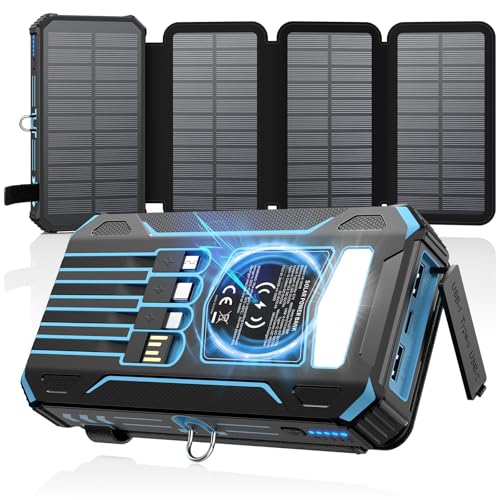
The first SOARAISE on the list goes big: a 48,000mAh lithium-polymer bank with four built-in solar panels, four integrated cables, and wireless charging on top. The 4-panel array charges the unit up to 5x faster than a single-panel solar bank, which is a meaningful difference when you only catch a few hours of sun.
Compared with the BigBlue 20,000mAh bank earlier, this one offers roughly 2.4x the stored energy at the cost of pocket space. For group trips and emergency kits, that headroom earns its weight.
The Good Stuff
- 48,000mAh capacity tops out multi-day off-grid use for multiple devices
- Four solar panels harvest meaningfully faster than single-panel banks
- Four built-in cables plus wireless charging cover almost any phone on the trip
- Works as an emergency household power source during outages
Points To Note
- Larger and heavier than 20,000mAh options like the BigBlue
- Wall charging from empty takes time at this capacity
- Owners commonly report real-world capacity running below the 48,000mAh headline figure
The Right Fit
Group campers and emergency-preparedness households who want a power bank that can be the wall outlet for a long weekend.
Another Choice May Suit
The BigBlue 20,000mAh bank is the lighter everyday carry for hikers who don’t need to feed four devices at once.
Functionally very close to its sibling above, this SOARAISE unit leans into wireless charging as the headline feature. Qi-compatible phones drop onto the top of the pack and start refilling without a cable, which is convenient at a picnic table or in a tent.
The four solar panels and four built-in cables still anchor the spec sheet, so this is best read as the wireless-focused version of pick 5. Same capacity, same form factor, different priority.
Why It Works Well
- Wireless Qi top-up removes a cable step for compatible phones
- 48,000mAh supports multiple devices over a long weekend
- Four solar panels still pull meaningful energy from full sun
- Built-in cables cover friends who forgot their own
A Few Limitations
- Wireless charging is slower than wired PD, even at the same capacity
- Size and weight make it a pack item, not a pocket item
- Solar top-up is a backup at this battery size, not a full refill
Quick Facts
Whose Shelf It Belongs On
Travelers and emergency kits where wireless top-up and cable flexibility matter more than absolute portability.
A Better Fit Elsewhere
The Goal Zero Nomad 10 is the right call for ultralight backpackers who want a panel, not a battery brick.
The third SOARAISE-style bank in this list trims the headline spec slightly and focuses on cable convenience. The 48,000mAh cell, four solar panels, and four built-in cables stay, and wireless charging is still part of the package.
For travelers tired of packing a tangle of Lightning, USB-C, and Micro-USB leads, the integrated cables are the selling point. The trade-off is the same as the others in this family: a brick-shaped object that earns its place in larger packs.
Features That Help
- Four built-in cables cover common device types without extras
- Wireless top-up works for Qi phones in a tent or at a campsite
- 4-panel solar design harvests faster than single-panel banks
- 48,000mAh cell supports multi-day power for groups
Points To Keep In Mind
- Bulkier than a 20,000mAh bank like the BigBlue
- Built-in cables add a small amount of daily wear at the hinge points
- Real-world usable capacity can read lower than the 48,000mAh label
Built With In Mind
Travelers, van-lifers, and emergency kits who want a “grab and go” power source that doesn’t demand a cable drawer.
Consider Something Else When
The Voltaic Systems Converter is the smarter choice for field work where you need a dedicated backpack-and-panel system with a stored battery.
The SolarGoPack leans into simplicity: a casual backpack with a detachable solar panel and a high-visibility yellow shell. It bundles a battery that can revive a dead phone from full sun, which is a nice safety net on day hikes and festival weekends.
Compared with the Outdoor Tech Mountaineer above, the SolarGoPack targets a less technical audience. The yellow color also helps with roadside visibility, which is a quiet bonus for cyclists and pedestrians.
Where It Helps
- Detachable solar panel keeps the bag itself lighter for casual use
- Bundled battery covers emergency top-ups on day trips
- High-visibility yellow shell improves roadside and trail visibility
- Approachable price and simple feature set for first-time solar buyers
Small Caveats
- Lower panel output than a dedicated 40W panel like the MHPOWOS
- Pack construction is lighter than technical backcountry bags
- Best suited to sunny day trips, not multi-day backcountry use
Right Fit For
Day hikers, festival-goers, and casual commuters who want a friendly entry point into solar charging without extra gear.
Not Your Match When
You need a true multi-day pack with deeper trail geometry, in which case the Outdoor Tech Mountaineer is the stronger option.
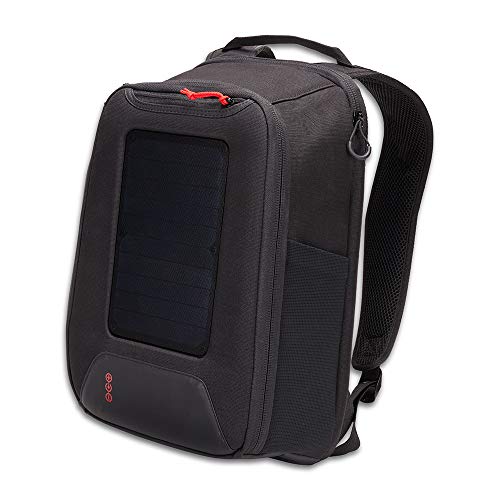
The Voltaic Systems Converter is the most “field tool” pick on the list. It includes a V25 battery pack that stores solar energy and feeds it to phones, tablets, and USB devices on demand, which is exactly the workflow researchers, journalists, and remote workers rely on.
Rugged fabric and tested solar cells target daily professional use, and a 2-year panel warranty (1 year on the battery) puts it ahead of most casual packs. For most recreational users it’s overkill; for a few, it’s the right tool.
What Pays Off
- Includes a V25 battery pack for stored solar energy
- Compatible with phones, tablets, and standard USB devices
- 2-year panel warranty outlasts typical consumer coverage
- Rugged fabric and solar cells built for daily professional wear
Things To Consider
- Priced higher than most casual solar backpacks in this list
- Style is utility-first, not fashion-first
- Bulkier than a commuter bag like the TOZLU laptop bag
Feature Card
Who Should Grab It
Field researchers, journalists, and remote-work professionals who need a panel-plus-battery system they can rely on weekly.
Not Your Match When
Recreational day hikers will find the Outdoor Tech Mountaineer a more comfortable fit for casual weekend use.
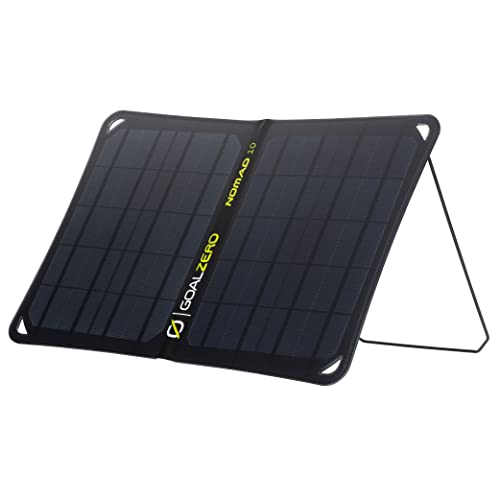
The Goal Zero Nomad 10 is the lightest panel on this list at about 1.2 lbs, with a folded footprint around 9.5 x 7.2 inches. The 10W monocrystalline panel and built-in USB port aim straight at the ultralight crowd.
The 180° kickstand is the unsung feature: prop the panel toward the sun on a break, hook it to a pack while walking, and let it drip-charge a phone or small power bank. Compared with the MHPOWOS 40W panel, you trade a lot of wattage for a lot less weight.
Positive Points
- 1.2 lbs total weight barely registers on a long trek
- Folded size of about 9.5 x 7.2 x 1.2 in fits a pack lid or side pocket
- 180° adjustable kickstand angles the panel toward the sun
- 10W monocrystalline cell delivers efficient output for the size
A Few Things To Weigh
- 10W output is meaningfully lower than 40W panels like the MHPOWOS
- Only a USB port, no USB-C PD or DC outputs
- Works best as a daytime trickle-charge, not a fast refill
Key Product Details
Right Fit For
Thru-hikers and ultralight backpackers who measure every gram and only need to top up a phone or small battery bank.
A Better Fit Elsewhere
The MHPOWOS 40W panel is the right pick for car campers who need higher output and more port variety.
Picking The Right Setup For The Way You Travel
Solar gear splits into three practical families. Integrated backpacks like the Mountaineer, TOZLU, SolarGoPack, and Voltaic Converter carry your load and charge at the same time, which is the simplest one-piece solution for commuters and day hikers. Standalone panels like the MHPOWOS 40W and Goal Zero Nomad 10 clip to whatever pack you already own and pour energy directly into your devices or a battery bank. Solar power banks like the BigBlue 20,000mAh and the SOARAISE 48,000mAh units store energy first and deliver it later, which matters when the sun goes behind a cloud right when you need a charge.
Wattage is only part of the story. A 40W panel in deep shade can produce less power than a 10W panel in direct sun, so honest conditions matter more than the printed spec. Battery capacity is measured in mAh, which describes stored energy in the bank itself, not the energy your phone actually receives. Built-in cables and wireless Qi pads reduce what you have to pack, but they add weight to the unit and create hinge points that wear with daily use. Warranty terms are worth scanning, especially the Voltaic panel’s 2-year coverage, because outdoor gear takes more abuse than indoor electronics.
For most people, the honest read is this: a 10-20W panel or a 20,000mAh solar bank covers casual trips, while a 40W panel or a 48,000mAh bank earns its weight on multi-day adventures. Pick the family that matches the trip, then worry about wattage.
Key Considerations Across These Picks
Common Shopping Slip Ups
Treating “solar charger” as one product category is the first misstep, because a backpack, a panel, and a power bank behave very differently. The second is chasing peak wattage without checking the port list, since a 40W panel with the wrong port is useless for your specific device. Finally, assume you’ll charge through partial shade and clouds, not just direct sun, and size up accordingly.
What The Higher Tier Buys
More expensive solar gear usually pays for tougher fabrics, verified battery cells, longer warranties, and better port selection rather than raw wattage. The Voltaic Converter’s 2-year panel coverage and the BigBlue’s DEKRA-verified capacity are good examples: you’re paying for the assurance that the unit survives real use. For a once-a-year festival weekend, a budget option makes sense. For daily commuters or field workers, the tier above is often the cheaper choice over a few years.
Frequently Asked Questions
How fast do backpack solar chargers actually charge a phone? In direct midday sun, a 10W panel typically refills a modern phone in 2-4 hours, while a 20,000mAh power bank tops it up in about an hour from wall current. Cloud cover and shade can cut real-world output by 50% or more.
Can a solar backpack charge a laptop? Most solar backpacks, including the Mountaineer and TOZLU, output 5V USB and lack the wattage and voltage profile to charge a laptop directly. Pairing a high-wattage panel with a USB-C laptop or using a dedicated laptop power station is the practical path.
Are solar power banks worth the extra weight? For trips longer than two days, a 20,000mAh or 48,000mAh bank usually pays for itself by storing energy during the day and delivering it at night. For day trips, a small panel is often lighter and simpler.
How long do solar panels last on these products? Modern monocrystalline and polycrystalline panels typically last 5+ years of regular use. The Voltaic Systems unit adds a 2-year panel warranty, which is longer than most consumer options in this list.
Can I leave a solar power bank in the sun all day? You can, but lithium-polymer cells degrade faster under sustained heat. A common practice is to top up the bank for a few peak hours, then store it in shade while the connected device draws from the bank.
Final Verdict
The right backpack solar charger depends on the trip, not the spec sheet. Casual day hikers and commuters will get the most from a friendly integrated bag like the Outdoor Tech Mountaineer or the TOZLU laptop bag. Long-haul travelers and field workers will lean toward the Voltaic Converter or the MHPOWOS 40W panel. Pick the format that fits how you actually move, and the rest of the decision tends to fall into place.