Carbon monoxide is colorless, odorless, and a genuine threat in cramped hotel rooms, sleeper vans, and rental cabins with aging furnaces. Travelers who worry about fuel-burning heaters, propane stoves idling in an RV, or garages that double as sleeping quarters benefit most from a small, reliable CO alarm that lives in the suitcase. This roundup gathers compact, battery-friendly, and easy-to-position detectors that hold up to the realities of life on the road.
A Fast Comparison Of The Options

Heiman Mini CO Alarm Low-Level Digital Display

Siterlink Plug-In CO Detector 10-Year Battery

Heiman CO Detector 3 Pack Low-Level Display
Kidde Portable AA Battery CO Alarm

Kidde Plug-In CO Detector 9V Backup

Heiman Battery Photoelectric Smoke Alarm

Heiman Wireless Interconnected Smoke 3 Pack
Kidde Plug-In CO Detector AA Backup

Heiman Photoelectric Battery Smoke Alarm
The Strengths Of Each Pick
This tiny Heiman unit slides into a carry-on pouch and wakes up at the first sign of trouble, which is exactly what you want from a travel detector. Activation takes one push of the included bracket into the back groove, then it runs on its own until the battery reaches end-of-life. The digital readout gives you real-time CO concentration in parts per million, so you can see rising levels before the alarm sounds.
For nomadic stays in older cabins, hostels, or guesthouses, the peace of mind is worth the space it takes. Frequent flyers who hop hotels every few days may find themselves swapping rooms faster than the battery depletes, which is a non-issue here.
Where It Delivers
- Sealed CR-2/3AZ lithium battery that lasts the lifetime of the unit, no swaps in the field.
- Compact footprint slips into a laptop sleeve or carry-on without bulging.
- Low-level digital readout shows CO concentrations below the alarm threshold, useful for spotting slow leaks from fuel-burning heaters.
- UL 2034 5th Edition certification and CSFM approval for residential and rental use.
Things To Consider
- Once activated, the unit cannot be switched off until the battery ends its service life, so plan placement carefully.
- No digital readout means no peak memory, just a basic threshold alarm.
Feature Snapshot
Right Fit For
Long-haul travelers who want a set-and-forget CO alarm they can toss in a bag for years of trips without battery swaps.
Reach For A Different Pick When
You’d rather skip the digital screen and pay less for a basic tabletop unit, in which case the Kidde Portable AA Battery CO Alarm is a better match.
Plug-in detectors belong in places where you know there’s a working outlet, like hotel rooms, Airbnb rentals, and home rentals where you intend to stay more than a night. The Siterlink model uses AC power for continuous operation and switches to a 10-year replaceable battery when the lights go out, so a blackout at a roadside motel won’t leave you unprotected.
The electrochemical sensor inside responds quickly to rising CO levels, which matters when you’re sleeping in an unfamiliar space with a gas heater that hasn’t been serviced recently. You trade portability for always-on protection.
Advantages To Know
- Standard outlet plug means no tools, no wiring, and no hunting for a flat spot on the wall.
- 10-year battery backup keeps the alarm functional through power outages common at older inns and motels.
- Replaceable backup battery extends service life beyond the typical sealed-cell design.
- Continuous AC power keeps the sensor warmed up and ready to react faster than cold-start battery units.
Worth Noting
- Outlet placement dictates where you can put it, so a room with only one reachable outlet may limit positioning.
- Less useful for tent camping or RV travel where 120V outlets aren’t standard.
Made For
Travelers who stay in hotels, B&Bs, or rental homes with reliable wall outlets and want always-on CO monitoring.
Consider Something Else When
You’re heading off-grid or sleeping in a van, in which case the Heiman Mini CO Alarm Low-Level Digital Display runs on its own battery without needing an outlet.
Three detectors in one box solve the problem that one unit can’t: monitoring multiple rooms at once. Battery power rather than plug-in keeps this 3-pack flexible, letting you scatter units across a rental home, an RV, or a large hotel suite without hunting for outlets.
Each unit carries the same UL 2034 5nd Edition safety certification as the single Heiman model, so you’re not trading away protection for the multi-pack savings. The digital screen on each face shows CO concentration in real time. Travelers splitting time between cities often stash one unit per frequent destination.
Standout Benefits
- Triple-pack covers a full home, RV, or multi-room rental for less than buying singles.
- 2 AA battery power means flexible placement anywhere, no outlet needed.
- UL 2034 5th Edition certified for residential alarm compliance.
- Digital display on each unit helps catch slow leaks from fuel-burning appliances before they escalate.
Trade Offs
- AA batteries require periodic replacement, unlike the sealed lithium option on the single Heiman Mini.
- Three units to keep track of, which can be a hassle if you rotate between short trips.
Quick Facts
Best Suited To
Families or groups who split between a few properties and want a detector stationed at each location without buying singles.
Look Elsewhere When
You only need one detector for one trip, in which case the Heiman Mini CO Alarm Low-Level Digital Display saves space and skips battery swaps.
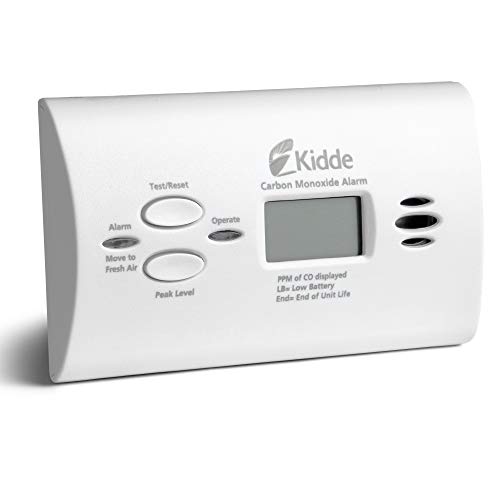
The Kidde portable leans into “set it anywhere” simplicity. A traveler can drop it on a hotel nightstand, a picnic table in a cabin, or the back seat of an SUV without mounting hardware. Two AA batteries keep the alarm running through power outages, which matters in older properties with spotty wiring.
The basic LED indicators keep the unit simple to interpret, with green for power and a loud tone when danger arrives. You won’t get the digital readout found on the Heiman models, but the trade-off is a simpler interface that needs no explanation.
Real-World Strengths
- Toss it in luggage, on a picnic table, or in a tent, no mounting hardware needed.
- 2 AA batteries keep it running when the lights go out at rural inns or campgrounds.
- Green LED confirms power at a glance, red LED signals danger with an 85-decibel alarm.
- Test-reset button lets you confirm function with one press before settling down for the night.
Points To Note
- AA batteries need replacing during service life, so pack spares for long trips.
- No digital readout, so you only see alerts rather than current CO concentration.
Perfect Match For
Road-trippers, RVers, and cabin regulars who need a grab-anywhere alarm without committing to outlet placement.
Swap It Out When
You want a screen that shows CO concentration in real time, in which case the Heiman CO Detector 3 Pack Low-Level Display offers that in a multi-pack format.
Plug it in, and the Kidde starts protecting immediately, which is exactly what you want in a rental where you don’t plan to mount anything to the wall. The 9V battery backup takes over during outages, common in older rural properties where the lights flicker just when you don’t want them to.
Unlike the Kidde Portable above, this model adds a digital LED display and a peak level memory feature that records the last CO reading. Useful when you wake up feeling off and want to know if CO crept in while you slept.
A Few Highlights
- Digital LED display shows current CO concentration and peak memory for the last reading.
- 9V battery backup handles brief outages without dropping protection.
- Plug-in design means no tools or wall mounting in a rental you don’t own.
- LED status indicators and an 85 dB alarm provide dual warning signals.
Trade Offs
- 9V backup battery is more limited than the 10-year battery on the Siterlink unit.
- Outlet location dictates placement, so rooms with limited outlets restrict where you can put it.
Built With In Mind
Long-stay renters and digital-readout fans who want peak memory to investigate morning headaches after a stay.
Consider Something Else When
You want a longer-lasting backup battery and don’t need peak memory, in which case the Siterlink Plug-In CO Detector 10-Year Battery fits better.
The Heiman Battery Photoelectric unit earns its design badge honestly. It’s a smoke detector rather than a CO alarm, which matters: CO threats are invisible, but slow smoldering fires from a forgotten stovetop or a space heater knocked over also deserve monitoring in vacation rentals.
The photoelectric sensing chamber responds to smoldering smoke faster than ionization technology, useful for catching the kind of fire that starts while you sleep. The compact, low-profile body earned a Red Dot Design Award for fitting into modern interiors without dominating the wall.
A Strong Showing
- Compact low-profile design earned a Red Dot Design Award for blending into modern interiors.
- Photoelectric sensing chamber detects smoldering fires faster than ionization units.
- UL 217 10th Edition certified to the latest North American smoke alarm standard.
- Battery-operated for placement anywhere without wiring constraints.
Minor Gripes
- Smoke detection only, no CO sensor, so pair it with a dedicated CO unit for full coverage.
- Battery replacement is part of ownership, plan a check at each trip’s beginning.
Core Details
Right Fit For
Travelers who stay in modern rentals with strict aesthetic standards and want a smoke detector that doesn’t stick out.
A Better Fit Elsewhere
If you need combined smoke and CO protection in one unit, look at the Kidde Plug-In CO Detector 9V Backup as a sibling pick with CO coverage.
Interconnected alarms solve the sleeping-through-the-fire problem. When one unit in this Heiman 3-pack senses smoke, every connected alarm sounds together, so a fire in the kitchen wakes you up even if you’re asleep in a back bedroom. Wireless interconnection range runs up to 656 feet in open areas, generous for a multi-room rental or a large vacation home.
Important to note: this is a smoke-only system, not a CO detection network. For CO coverage you’d still need a separate carbon monoxide unit like the Siterlink Plug-In CO Detector 10-Year Battery elsewhere in the same space.
Practical Pluses
- Wireless interconnection range up to 656 ft covers large vacation rentals and multi-floor layouts.
- Triple-pack spreads coverage across multiple rooms without buying singles.
- All interconnected alarms sound together, so a kitchen fire wakes the back bedroom.
Where It May Fall Short
- Smoke detection only, no CO sensing, so pair with a dedicated CO unit.
- Doesn’t connect to a smartphone app for remote alerts when you’re away from the property.
Who It Suits Best
Travelers booking larger vacation rentals, multi-floor cabins, or guesthouses who want whole-property smoke coverage from one purchase.
Skip It When
You’re staying in a single small room and don’t need multi-unit coverage, in which case the Heiman Battery Photoelectric Smoke Alarm gives you one compact unit instead.
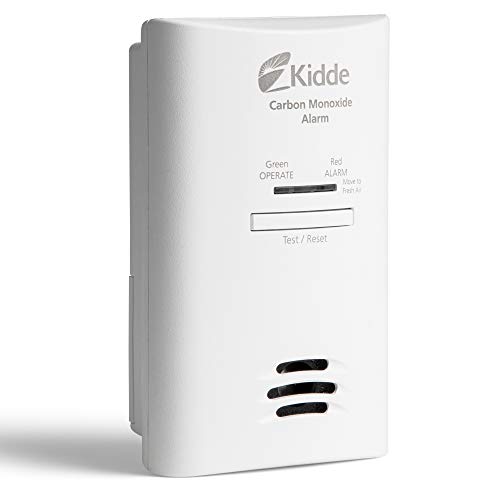
Plug it in, the alarm runs on AC power, and when the lights flicker out, two AA batteries step in to keep protection continuous. That’s the practical story of the Kidde Plug-In AA model, similar to the older Kidde Plug-In above but with AA backup rather than a 9V cell.
AA cells are easier to find at any roadside gas station or pharmacy than 9V batteries, which matters when you’re traveling. The trade-off is shorter backup runtime compared to the Siterlink’s 10-year battery option.
Useful Strengths
- AA backup batteries are widely available at pharmacies and gas stations during travel.
- Plug-in design means zero mounting work in a property you don’t own.
- Test-hush button lets you silence nuisance alarms during cooking or open-fireplace stays.
- LED status indicators give quick at-a-glance feedback on alarm condition.
Soft Spots
- AA backup runs shorter than the Siterlink’s 10-year cell during extended outages.
- Outlet location constrains placement to wherever there’s a reachable socket.
Feature Card
Perfect Match For
Outlet-first travelers who want plug-in simplicity with backup batteries they can replace anywhere on the road.
Look Elsewhere When
You’d rather skip the outlet hunt and travel with a battery-only unit, in which case the Kidde Portable AA Battery CO Alarm fits better.
This single-unit Heiman smoke alarm does what the multi-pack does for one room. Photoelectric sensing catches slow-smoldering fires faster than ionization chambers, useful for catching a forgotten stovetop burner or a tipped space heater before flames erupt.
Travelers who bounce between single-room stays and don’t need the multi-unit network often find one of these is enough. Battery-only operation keeps placement simple.
Strong Points
- Single compact unit travels easily in a small bag without taking much room.
- Photoelectric sensing detects smoldering fires faster than ionization technology.
- Battery-powered design needs no outlet, so you can place it on a shelf or nightstand.
- UL 217 10th Edition certified to the latest smoke alarm standard.
Honest Caveats
- Smoke detection only, no CO sensing, so pair with a separate CO alarm for full coverage.
- Single unit, so a multi-room rental may need additional alarms elsewhere.
Made For
Solo travelers in small rooms who want a single, lightweight smoke alarm they can pack without ceremony.
Swap It Out When
You need whole-property coverage from one purchase, in which case the Heiman Wireless Interconnected Smoke 3 Pack spreads protection across multiple rooms.
What Matters Most Before Choosing Carbon Monoxide Travel Detectors
Sensor technology matters most. Electrochemical CO sensors respond accurately across low and high concentrations, while smoke alarms split between photoelectric and ionization designs. Photoelectric chambers catch smoldering fires faster, making them a strong fit for sleeping spaces where you want advance warning.
Power source shapes travel convenience. Sealed lithium batteries last the unit’s lifetime, AA cells are easy to replace on the road, and plug-in designs keep the sensor always warmed up but tie you to outlet placement. Travelers who move between off-grid camping and hotel stays benefit from flexible battery power, while renters with reliable outlets lean toward plug-in models.
Certifications provide a baseline. UL 2034 for CO alarms and UL 217 for smoke alarms confirm the unit meets North American safety standards. Without third-party testing, claims about protection are just words.
Backup features vary widely. Plug-in models with battery backup handle brief outages at rural properties, while interconnected smoke alarms ensure one triggered unit wakes every bedroom. Match the backup design to the property type you frequent.
Key Things To Weigh Up Before Buying
Common Buying Slip Ups To Avoid
Picking a smoke detector when you actually face a CO threat is the most common mistake. CO needs an electrochemical sensor, not a photoelectric smoke chamber. Travelers with gas heaters, propane stoves, or attached garages need dedicated CO coverage. Skipping the backup battery on a plug-in unit leaves you exposed during outages common at older rural inns and roadside motels.
What Separates Premium Picks From Basic Units
Higher-tier models add digital displays that show real-time CO concentration, peak memory that records the last alarm reading, and longer-life backup batteries that outlast the trip itself. Wireless interconnection in multi-packs spreads alerts across rooms, useful for larger rentals. For a single-room trip, the basic tier handles the job without spending on features you won’t use.
Frequently Asked Questions
How long do carbon monoxide travel detectors actually last? Most portable CO alarms run for 5 to 10 years before the sensor reaches end-of-service, signaled by a chirp or LED indicator. Sealed lithium models run until depletion, while plug-in units depend on backup battery swaps.
Can I use a smoke alarm as a carbon monoxide detector? No. Smoke alarms respond to airborne particles, not CO gas. You need a dedicated electrochemical CO sensor to detect carbon monoxide. Many travelers carry both for full coverage.
Where should I place a travel CO detector in a hotel room? Set it on a nightstand or shelf near where you sleep, ideally at breathing height rather than the floor. Keep it away from windows and direct airflow from heaters, which can fool the sensor.
Are plug-in CO detectors better than battery-only models? Plug-in units stay continuously powered, keeping the sensor warmed and responsive, but battery-only models travel anywhere without hunting for outlets. Match the design to how you actually move.
Do carbon monoxide detectors work internationally? The sensor technology works worldwide, but plug-in models need a 120V outlet or a plug adapter for foreign sockets. Battery-powered units travel anywhere without adapter hassle.
Final Verdict
A small, reliable CO alarm earns its space in any travel kit. Pick the Heiman Mini CO Alarm for sealed-battery simplicity, the Siterlink Plug-In for always-on outlet use, or the Kidde Portable for grab-anywhere flexibility. Match the power source and sensor type to where you stay, and you’ll have one less thing to worry about on the road.