Living the RV life means chasing sunsets, but weak cell signal can sour the trip fast. The right booster turns a one-bar campsite into a workable spot for video calls, streaming, and navigation. This roundup covers home-style boosters that travel well and RV-built kits that handle road vibration, so you can stay connected from a national park pullout or a remote boondocking site.
A Closer Look At The Lineup

BrstsWhel Home Signal Booster 7000 Sq.Ft

HXSDplus Home Signal Booster 7000Sq. Ft (Green)

YLXONE Home Signal Booster 2000 sq ft (Black)

SNDcellup Home Signal Booster 5500Sq Ft (Grey)

BoostHome Multi-Room Signal Booster 8000 sq ft

weBoost Drive Reach RV II Signal Booster Kit

weBoost Drive Reach RV Signal Booster Kit
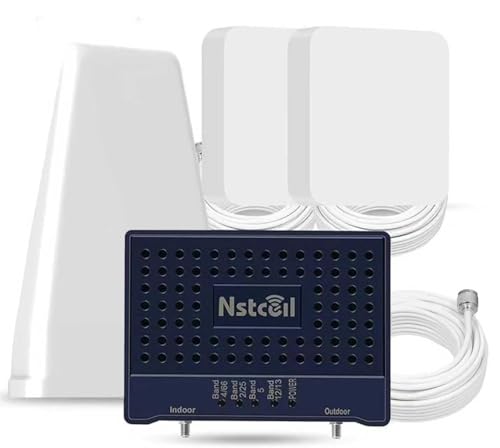
BoostHome Multi-Room Signal Booster 7000 sq ft
The BrstsWhel booster scales its indoor coverage based on whatever signal reaches the outside antenna. One bar outside might give you around 800 square feet, while a stronger five-bar catch can stretch the same hardware across a full 7,000 square feet. For RV owners who anchor in different terrain each week, that adaptive range removes the guesswork from picking a single-coverage model.
Installation requires mounting the outdoor log-periodic antenna and keeping roughly 32 feet of separation from the indoor panel. Power down before adjusting antennas to avoid signal feedback. Compared with the heavier 8,000-square-foot BoostHome later in this list, the BrstsWhel trades raw footprint for flexibility, giving owners a unit that responds to real-world signal swings rather than a fixed ceiling.
What Works In Its Favor
- Adaptive coverage from 800 to 7,000 sq ft based on outside signal strength
- Supports 5G through DSS (Dynamic Spectrum Sharing) deployment on existing 4G bands
- Single-indoor antenna keeps the install footprint manageable for tight RV interiors
- Compatible across all major U.S. carriers for voice, text, and data
Things To Consider
- Requires at least a minimal outside signal to function; dead zones stay dead
- 32-foot antenna separation can be awkward in compact rig layouts
- Higher gain figures depend entirely on real outdoor signal, not lab conditions
Who It Suits Best
Full-time RVers who move between varied signal environments and want one booster that adjusts instead of failing outright in weak zones.
Where Another Pick Suits Better
Drivers needing a vibration-rated RV kit should reach for the weBoost Drive Reach RV II, which ships with RV-specific mounting hardware.
HXSDplus ships with two indoor antennas instead of one, which spreads signal across longer or L-shaped interiors without a major rewiring job. A 70 dB gain figure pairs with the 7,000-square-foot ceiling, helping the unit lift weak rural signals into usable indoor coverage. The green color is a small touch, but the dual-antenna layout is the real story for stretched RV floorplans.
For full-time travelers parking in remote regions, the dual setup means you can place one antenna near the cab and another toward the bedroom. That matters when the booster itself sits near the exterior antenna feed. Against the BrstsWhel’s single-antenna approach in the previous pick, the HXSDplus trades some simplicity for better signal distribution in longer rigs.
A Few Highlights
- Dual indoor antennas cover split or elongated RV interiors
- 70 dB gain supports weak rural signal recovery
- Up to 7,000 sq ft rated coverage when input signal cooperates
- Compatible with U.S. and Canadian carrier networks
Points To Keep In Mind
- Two antennas mean more cable routing and more mounting decisions
- Real coverage still depends on outdoor signal strength at the camp spot
- Coaxial runs through slide-outs can wear over time on rough roads
Right Fit For
RVers with longer coaches or fifth wheels who need signal in both living and sleeping zones without chaining together multiple boosters.
Swap It Out When
You camp in compact vans where a single-antenna model like the YLXONE will route fewer cables through a tight space.
The YLXONE covers up to 2,000 square feet, a deliberate step down from the larger units earlier in this list. That smaller ceiling is useful when you actually only need one or two rooms lit up, especially in a camper van or truck camper where overshooting coverage just wastes power. Band coverage includes 66, 25, 2, 4, 5, 12, 13, and 17, so it catches most U.S. carrier deployments.
For urban weekend warriors parking at trailheads or fairgrounds with decent tower proximity, this unit’s smaller footprint fits where bigger boosters feel excessive. Compared with the HXSDplus dual-antenna layout above, the YLXONE simplifies things: one antenna, one cable path, less to stow when you break camp.
Positive Points
- 2000 sq ft ceiling suits smaller rigs without overspending on unused range
- Eight-band compatibility covers most U.S. carrier frequencies
- Single-antenna setup reduces cable clutter in compact spaces
- Boosts 5G and 4G data for streaming and navigation
Honest Caveats
- Coverage ceiling drops sharply with weak outdoor signal
- Not designed for multi-zone coaches over 30 feet long
- Outdoor antenna still needs proper grounding during storms
Best Suited To
Weekend campers and van lifers with small interiors who want signal without installing dual antennas or running long cable runs.
Consider Something Else When
You tow a long fifth wheel where the dual-antenna HXSDplus will reach both ends of the rig more evenly.
Quick Facts
The SNDcellup lands in the middle of this list with a 5,500-square-foot ceiling and broad band support across 2, 25, 4, 66, 5, 12, 17, and 13. That range suits mid-sized motorhomes and travel trailers where you want signal in the cab, kitchen, and bedroom without maxing out the largest models. The grey housing is plain but unobtrusive when mounted in a cabinet.
Family travelers running multiple devices at once (tablets for kids, hotspots for work, phones for navigation) tend to push the limits of smaller boosters. The SNDcellup’s middle-ground capacity handles that load better than the YLXONE while costing less attention than the 8,000-square-foot option later in this list.
What Makes Sense
- Mid-tier coverage handles family-sized rigs without overshooting
- Eight-band support catches most carrier frequency variations
- Single-antenna design keeps install manageable
- Compatible across all U.S. carriers for voice and data
Where It May Fall Short
- Single indoor antenna limits reach in elongated layouts
- Coverage ceiling shrinks noticeably with weak outdoor signal
- Outdoor antenna needs careful sealing against roof moisture over time
Made For
Family RV trips where multiple devices compete for signal and the rig falls between compact van and full-size coach dimensions.
Reach For A Different Pick When
Your coach stretches beyond 35 feet and signal needs to reach a rear bedroom, where the HXSDplus dual-antenna setup distributes coverage better.
The BoostHome multi-room model pushes the largest ceiling in this roundup at 8,000 square feet, paired with two indoor antennas for broad distribution. For long-haul touring coaches and toy haulers that function as rolling offices, the wider coverage handles video calls in the lounge and bedtime streaming in the bedroom from one booster. Multiple-device households benefit most from this footprint.
Setting realistic expectations matters here. Hitting the 8,000-square-foot rating requires decent outdoor signal at the antenna feed. In a canyon or dense forest pullout, performance drops regardless of hardware. Against the SNDcellup’s mid-tier 5,500-square-foot ceiling earlier in this list, this unit offers headroom for larger coaches but with more antenna cabling to manage.
The Value In It
- Top ceiling at 8,000 sq ft for large motorhomes and trailers
- Dual indoor antennas reach front lounge and rear bedroom separately
- Multi-carrier support keeps the whole family connected at once
- Handles 5G and 4G data for hotspot-driven remote work
Some Limits To Know
- Coverage ceiling drops sharply when outdoor signal is marginal
- Two antennas add cable routing complexity during install
- Larger unit draws more power from RV battery banks than smaller boosters
Perfect Match For
Full-time RVers in large Class A coaches who treat their rig as a connected home office and need signal everywhere from the cab to the bedroom.
A Better Fit Elsewhere
Short weekend trips in compact vans where the YLXONE’s smaller footprint and lower power draw make more practical sense than this unit’s reach.
Feature Snapshot
The weBoost Drive Reach RV II is built for moving rigs rather than stationary homes. The mounting bracket adjusts 180 degrees in both directions, letting you aim the outside antenna while parked or in transit. A new cable entry cover supports cleaner routing through RV walls, and the 25-foot cable run accommodates tall Class A roof lines without extension accessories.
Compared with the home-targeted BoostHome units earlier in this list, the Drive Reach RV II focuses on durability and signal reach rather than raw square-footage. Owners commonly report this kit extending usable signal reach several times over baseline, especially in fringe coverage areas along interstates. For those who keep moving, the RV-specific design matters more than home-style ratings.
Real Benefits
- RV-rated mounting bracket handles road vibration and aim adjustments
- 25-foot cable accommodates tall motorhome roofs
- Cable entry cover supports clean wall routing without gaps
- Boosts 4G LTE and 5G across Verizon, AT&T, T-Mobile, and others
Less Ideal Details
- Coverage ceiling is lower than the largest home boosters in this list
- External antenna mounting requires drilling or T-slot hardware on the roof
- Premium RV-specific kit carries a higher cost than stationary alternatives
Built With In Mind
Frequent travelers and full-timers who drive between campsites and need signal that works in motion or after a quick park-and-setup.
Not Your Match When
You camp in one spot for months at a time and want maximum indoor coverage, where the BoostHome 8,000 sq ft model will spread signal further indoors.
Feature Card
The original Drive Reach RV predates the RV II version but still delivers the core experience that made the line popular. Built in the U.S., it supports 4G LTE and 5G across all major U.S. carriers and handles both parked and in-motion use. The proven design appeals to RV owners who want a track record rather than a freshly updated spec sheet.
For travelers comparing the original Drive Reach RV against the newer RV II directly above in this list, the older kit typically costs less while keeping the same carrier support and multi-device capability. If you don’t need the updated cable entry cover or bracket refinements, this older version handles the same coverage job without the latest hardware tweaks.
Features That Help
- Designed specifically for mobile RV signal boosting
- Boosts signal for multiple devices simultaneously
- Compatible with Verizon, AT&T, T-Mobile, and other U.S. carriers
- Supports 4G LTE and 5G voice and data
Practical Considerations
- Older design lacks the RV II’s updated cable routing features
- Roof mounting still requires drilling or compatible brackets
- Reach improvements are real but depend on tower proximity at each stop
Who Will Love This
RVers who prioritize proven performance over the newest hardware revisions and want a kit with a longer field track record.
Look Elsewhere When
You prefer the latest cable management and bracket refinements, where the weBoost Drive Reach RV II delivers incremental but useful upgrades.
Technical Highlights
The BoostHome 7,000-square-foot model rounds out this list with wide band coverage across 66, 25, 2, 4, 5, 12, 13, and 17. That spread suits mixed-carrier households where one partner runs Verizon and the other runs T-Mobile, both streaming from the same rig. Coverage matches the BrstsWhel reviewed earlier, but the band lineup is broader.
For RV owners who split between urban camping and rural boondocking, the multi-band support reduces the chance of hitting a tower on a frequency your booster can’t reach. Compared with the weBoost Drive Reach RV kits above, this unit focuses on stationary home-style use rather than road-rated mounting. Stationary setups benefit from cleaner install without vibration concerns.
Everyday Perks
- Eight-band compatibility catches most U.S. carrier frequencies
- 7,000 sq ft ceiling fits mid-to-large RV interiors
- Boosts 5G and 4G data for video calls and streaming
- Multi-carrier support keeps mixed-plan households connected
Trade-Offs To Consider
- Home-style design lacks RV-specific mounting hardware for road use
- Coverage ceiling drops with weak outdoor signal at remote sites
- Single indoor antenna limits reach in elongated coaches
Whose Shelf It Belongs On
RVers who split between stationary long-term camping and mixed-carrier families wanting broad band support without road-rated mounting.
Another Choice May Suit
Frequent drivers should consider the weBoost Drive Reach RV II, which includes RV-specific mounting hardware built for road vibration.