Flying with clubs doesn’t have to drain your wallet, and the right travel cover keeps drivers, irons, and putters safe through baggage handlers, rental car trunks, and hotel storage. The picks below cover everything from budget-friendly soft cases to hard-shell haulers, so weekend golfers and frequent flyers alike can find a sensible match. Each one is sized to swallow a standard stand or cart bag, padded where it counts, and built to take a beating without weighing you down at the airport.
The Picks In Brief

Sun Mountain ClubGlider Meridian Travel Bag

BACK 2 BASICS Putting Mirror Carry Case

Sun Mountain ClubGlider Journey Travel Bag

Sun Mountain Meridian Travel Bag

Bag Boy Backbone Travel Cover

ASK ECHO Locklink StableRoller Travel Bag

KVV Hi-Protective Golf Travel Bag

Sun Mountain ClubGlider Meridian 4-Wheel
uniHimal Hard Case Golf Travel Bag

Sun Mountain Kube Travel Bag
What Each Pick Brings To The Table
Frequent flyers who dread hauling a fully loaded golf bag through long terminal corridors will appreciate the leg-supported design here. The extendable legs take the bag’s weight so the wheels glide rather than drag, which matters when you’re juggling a boarding pass and a coffee. Compared to a basic soft cover, this one feels engineered for the realities of airport navigation.
The padded top crown shields clubheads from the kind of impact that comes off conveyor belts and cargo holds. For golfers who log multiple trips each season, that extra engineering is the difference between worry-free travel and checking every headcover on arrival.
Where It Delivers
- Retractable legs lift weight off your arm during long walks
- Dense top padding absorbs direct hits on clubheads
- Pivoting wheels pivot smoothly around tight corners
- Full-length zippers make packing your bag straightforward
- Reinforced base handles curbside loading without scuffing
Things To Consider
- Bulkier than soft-shell options when stored at home
- Heavier empty weight, which adds to overall luggage
Built With In Mind
Golfers who fly with their full set at least four or five times a year will get their money’s worth out of this Meridian.
Consider Something Else When
Players tight on storage space should look at the Sun Mountain Kube, which folds down into a much friendlier cube between trips.
This one breaks the mold on purpose. Rather than a full club cover, the BACK 2 BASICS case protects a putting mirror and the small training aids that tend to get scratched in a suitcase. For golfers who travel with a putting gate or a putting ruler alongside their gear, the snug interior keeps everything from rattling around loose.
The lightweight build slips into a backpack or a larger travel bag without much fuss. Where the Meridian above is built for full-bag transport, this little pouch solves a much narrower, much cheaper problem, and it solves it cleanly.
Bright Spots
- Padded shell protects fragile mirror surfaces from pressure cracks
- Compact footprint fits inside lockers, desks, or larger bags
- Snug interior stops shifting that wears training-aid edges
Points To Note
- Only covers a putting mirror and small aids, not clubs
- Won’t replace a primary travel cover for full-bag trips
Right Fit For
Practice-focused golfers who travel with a putting aid and want scratch-free storage between sessions.
Look Elsewhere When
Anyone needing a full-bag travel cover should reach for the KVV Hi-Protective Golf Travel Bag instead, which is built around actual clubs.
The Journey takes the same ClubGlider concept as the Meridian but trims the package down. That makes it friendlier for golfers who’d rather not wrestle a 12-pound empty bag through an airline check-in line. The four-wheel base with swiveling fronts pulls cleanly across tile, carpet, and parking-lot asphalt.
Compared to the heavier Meridian, you give up a bit of headroom but keep the retractable legs that define the line. For mid-distance trips, that tradeoff usually lands in the right place.
A Few Strong Suits
- Lighter build than the larger Meridian, easier on overhead bins
- Four-wheel rolling base spins through airport turns
- Extendable legs remove weight from your arm during long walks
- Padded top section cushions clubheads from conveyor impacts
Honest Caveats
- Less internal room than a full-size Meridian cover
- Not ideal for oversized cart bags with extenders
Key Specs
Who Should Grab It
Golfers packing a standard stand bag for frequent flights will find the Journey’s wheel system and lighter frame easy to live with.
A Better Fit Elsewhere
Players carrying an oversized cart bag should consider the Sun Mountain Meridian, which offers more internal room for bulkier setups.
The original Meridian is the bag that put Sun Mountain’s ClubGlider name on the map, and its dense top foam does the heavy lifting in rough cargo holds. Pivoting caster wheels extend out to take the weight of a fully loaded stand bag, then tuck back in when the bag sits upright. That dual-mode design makes curbside check-ins feel far less awkward.
Compared to the lighter Journey above, this Meridian is a sturdier ride. Travelers who check their clubs at the counter rather than gate-checking tend to appreciate the thicker top crown and the heavy-duty full-length zippers.
Reasons It Performs
- Dense foam padding through the top section
- Pivoting caster wheels extend and retract on demand
- Heavy-duty full-length zippers resist splitting
- Stable base when legs deploy, keeping the bag upright
A Few Limitations
- Heavier empty weight than soft-shell or compact covers
- Takes up more closet space when not in use
Whose Shelf It Belongs On
Golfers who check their clubs as standard luggage and want peace of mind about overhead impacts will like the build here.
Skip It When
Players with limited storage should pivot to the Sun Mountain Kube, which folds into a fraction of the footprint.
The Backbone takes a different approach entirely. Instead of a soft-sided rolling case, it’s an aluminum frame with a polypropylene cap, designed to slide over your bag and absorb direct hits to the clubheads. The telescoping sections adjust up to 54 inches and collapse down to roughly 23, which is the kind of math that matters in a small apartment closet.
For golfers who fly only a couple of times a year and want something inexpensive to store the rest of the time, the telescoping design is a genuinely useful answer to a real annoyance. You get clubhead protection without the closet hog.
Standout Benefits
- Telescoping aluminum frame adjusts to bag length
- Collapses to 23.25 inches for compact storage
- Oversized polypropylene cap cushions clubhead blows
- Lightweight aluminum shaft keeps total weight low
- Push-button length adjustment on the go
Soft Spots
- Less full-coverage padding than rolling soft cases
- No wheels to help with curbside hauling
Feature Snapshot
Made For
Travelers with limited storage space who fly a few times a year and want something compact that still shields clubheads.
Swap It Out When
Frequent travelers who want a rolling option should pick the ASK ECHO Locklink StableRoller for its wheel base instead.
Where the Sun Mountain bags rely on retractable legs, the ASK ECHO Locklink StableRoller pairs a four-wheel base with fold-out support legs that keep the bag upright at the gate. The wheel arrangement lets you push or pull the loaded cover without lifting, which makes long walks through concourses feel shorter.
For golfers tired of watching their bag topple at the airline counter, the fold-out leg approach offers a stability story that simpler covers can’t match. It’s a thoughtful design move that solves one of the small but real annoyances of traveling with clubs.
Notable Gains
- Four-wheel base for smooth push or pull handling
- Fold-out support legs steady the bag during loading
- Locklink design adds structural integrity to the frame
- Wide base footprint resists tipping in crowds
Trade Offs
- Heavier than soft-shell bags with no rigid spine
- Takes up similar space to the Meridian when stored
Best Suited To
Golfers who travel through busy airports and need a stable platform that won’t tip during boarding calls.
Another Choice May Suit
Players chasing maximum cushioning should look at the uniHimal Hard Case Golf Travel Bag, which surrounds clubs in a crush-resistant shell.
First-time buyers who want club protection without a four-figure price tag will find the KVV’s combination of features genuinely useful. The 1680D Oxford cloth shell resists abrasion in cargo holds, while the extra padding on the top section is the part that actually matters during an overhead drop. Two internal straps cinch the bag down so it can’t slide around inside the cover.
The camouflage print isn’t going to win any fashion awards, but it does keep the bag easy to spot on a baggage carousel. That’s the small win most travelers don’t think about until they’re staring at three identical black cases.
Positive Takeaways
- 1680D Oxford cloth resists tearing under load
- Extra top padding protects the clubhead zone
- Two internal straps stabilize clubs during transit
- Multiple handles ease curbside lifting
- Foldable design saves closet space at home
Where It Is Less Suited
- Soft-shell build offers less impact protection than hard cases
- Camouflage pattern may not suit every taste
Feature Rundown
Perfect Match For
First-time buyers who want a real travel cover at a friendly price point and don’t need a hard shell.
Not Your Match When
Travelers worried about serious impacts should step up to the uniHimal Hard Case, which adds a crush-resistant outer shell.
This Meridian variant sharpens the wheeled experience with a wider four-wheel stance that tracks straighter down long corridors. The patented leg mechanism still supports the bag’s full weight, so the wheels glide rather than carry, and the swiveling front pair makes gate detours painless.
Compared to the original Meridian at #4, this four-wheel version is the better choice for travelers who log dozens of trips per year. You trade a bit of weight for noticeably smoother pushing over uneven ground.
Practical Advantages
- Wider four-wheel stance for smoother straight-line pushing
- Patented retractable legs support full bag weight
- Swiveling front wheels pivot through tight gates
- Heavy-duty construction built for repeat use
Things To Weigh
- Heavier than two-wheel rolling options
- More expensive than basic soft-shell covers
Who Will Love This
Golfers who travel monthly or more will find the durability and easy handling pay off quickly.
Where A Sibling Pick Shines
Casual travelers flying once or twice a year will be better served by the KVV Hi-Protective Golf Travel Bag, which costs less and folds flat.
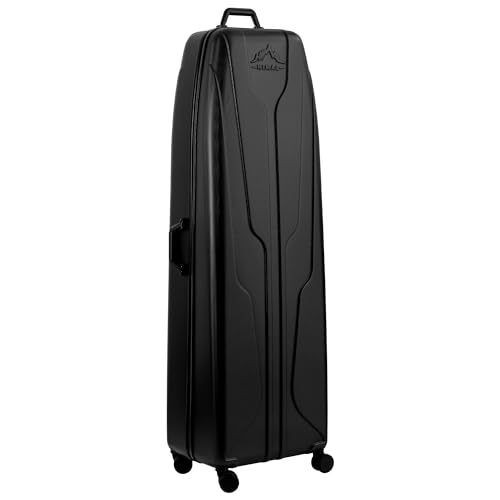
For travelers worried about rough baggage handlers or wet tarmac transfers, a hard shell changes the equation. The PC outer shell on the uniHimal resists crushing, and the waterproof surface keeps rain, slush, and snowmelt away from your grips and shafts. Thick interior padding catches any blow that does get through.
The fit window here matters. The interior accepts driver bags up to 46 inches long and 10.5 inches wide, so oversized tour bags won’t fit. For standard stand and cart bags, though, the protection ceiling is meaningfully higher than any soft-sided option on this list.
Everyday Perks
- PC hard outer shell resists crush damage
- Waterproof surface keeps clubs dry in wet conditions
- Thick interior padding cushions against secondary impacts
- Wide interior fits standard driver bags comfortably
Points To Keep In Mind
- Hard shell adds more weight than soft cases
- Larger footprint when not in active use
Spec Overview
Made For
Golfers flying through routes with rough baggage transfer points or unpredictable weather who want the highest protection ceiling.
Reach For A Different Pick When
Players with a smaller budget and lighter habits should pick the KVV Hi-Protective Golf Travel Bag, which trims cost at the cost of some impact protection.
The Kube solves a problem the rest of this list mostly ignores. When the trip ends, where does the cover live? The Kube folds into a compact hard-shell cube that fits in a closet, a car trunk, or a garage corner without dominating the floor space. That’s the appeal for golfers in apartments or shared homes.
The two-wheel rolling system is more straightforward than the four-wheel bases above, and that’s fine. Most users will roll it from front door to car, then check it at the counter. The folding trick is the headline feature, and it lives up to it.
A Favorable Mix
- Folds into a compact hard-shell cube for storage
- Two-wheel rolling system is easy to manage
- Heavy-duty construction for repeat use
- Stows in tight closets and small trunks
Some Limits To Know
- Two wheels require pulling rather than pushing
- Less internal padding than full Meridian models
Who It Suits Best
Golfers in apartments or homes with limited storage who still want a real travel cover for occasional flights.
Where Another Pick Suits Better
Players who fly enough to want four-wheel handling should choose the Sun Mountain ClubGlider Meridian 4-Wheel instead.
Picking The Right Cover For Your Game
Choosing a golf travel bag comes down to how often you fly, what you’re packing, and where the cover lives between trips. Frequent flyers benefit most from wheeled systems with leg support, since hauling a loaded bag through airports wears you down fast. Casual travelers who fly once or twice a year can usually get away with a simpler soft case or even a telescoping frame.
Protection Levels That Actually Matter
Top-end padding matters more than the shell fabric for most travelers. The clubhead zone takes the brunt of impact damage during baggage handling, so dense foam up top does the work that fancy exterior material cannot. Hard shells add a ceiling on impact damage but trade away storage size and weight savings.
Wheels, Legs, And Maneuverability
Two-wheel designs pull better but tip more easily. Four-wheel systems handle crowded terminals and tight gates more gracefully. Retractable legs take weight off your arm but add bulk to the cover. Storage-friendly options like folding cubes sacrifice some handling ease for closet-friendly footprints.
Sizing Your Bag To The Cover
Most covers fit standard stand bags up to about 46 inches long. Cart bags often need extra room and sometimes don’t fit. Always measure your bag’s longest dimension, including the driver headcover, before choosing. Oversized staff bags will narrow your options considerably.
Key Considerations Across These Picks
Common Buying Mistakes
Picking the cheapest option is tempting, but bags without top padding rarely survive a year of checked luggage. Skipping measurement checks leads to covers that won’t close around your bag. Assuming all wheels handle the same way leads to frustration when two-wheel designs need to be pulled through crowded gates.
Where The Extra Money Goes
Higher-tier models buy real engineering: retractable legs, four-wheel swiveling bases, and reinforced zippers that don’t split under load. The upgrade payoff shows up most clearly in how many trips a cover handles before showing damage. Travelers logging multiple trips a season recoup the cost through fewer replacement purchases and fewer damaged clubs.