A 65-liter pack sits in the sweet spot for serious backcountry travel, carrying enough for a week of cold-weather gear or a long hut-to-hut trek without forcing you into expedition-sized bulk. Comfort over long miles matters as much as raw volume, and ventilation under a heavy load can decide whether your shoulders survive day three. The eight packs below span premium suspension systems, lightweight stripped-down builds, women’s-specific fits, and budget-friendly haulers, giving you real options at every experience level.
The Choices Worth Comparing

Osprey Atmos AG 65L Men’s Backpacking Backpack (Black L-XL)
Osprey Atmos AG LT 65L Men’s Backpacking Backpack (Black L-XL)

Osprey Aura AG 65L Women’s Backpacking Backpack (Red WM-L)
Teton 65L Explorer Internal Frame Backpack (Graphite)

Mardingtop 65L+10L Internal Frame Backpack with Rain Cover

Osprey Rook 65L Men’s Backpacking Backpack (Blue OS)

Kelty Coyote 60-105 Liter Internal Frame Backpack (65L / Dark Olive)
SKYSPER Anti Theft Hiking Backpack 18L RFID Packable
What Each Pick Brings To The Table
The Atmos AG 65 earns the top slot because it solves the most common 65-liter complaint: a hot, sweaty back on long climbs. Its signature AntiGravity suspension uses a tensioned mesh panel that bridges from the lumbar pad to the upper harness, lifting the pack’s body off your spine so air can move underneath. Across a six-day Sierra section in midsummer, that mesh cradle makes the difference between finishing a climb feeling beat up and finishing feeling tired but intact.
Compared to the Atmos AG LT covered next, the standard Atmos AG trims less weight and adds more backcountry features: a built-in raincover, stretch side pockets for water bottles or tent poles, and Osprey’s Stow-on-the-Go trekking pole attachments. You get a stable ride when the load pushes past 40 pounds, the kind most weekend warriors never exceed. L-XL sizing fits torsos roughly 20 to 23 inches, which covers most adults carrying gear for two.
What It Does Well
- AntiGravity mesh suspension vents heat across your lumbar and shoulders, real comfort on warm, exposed routes.
- AntiGravity back panel wraps hips in a seamless 3D mesh that spreads load without pressure points.
- Stretch side pockets swallow full-size water bottles and small stuff sacks without straps.
- Stow-on-the-Go trekking pole attachment lets you stash poles without removing the pack.
- Built-in raincover deploys fast when afternoon storms roll in.
Trade-Offs Worth Knowing
- Heavier than ultralight competition, since suspension plus padding carry their own weight.
- Mesh suspension collects dust and trail debris and may need occasional brushing.
- Premium pricing puts it out of reach for casual once-a-year campers.
Quick Facts
Whose Trail This Belongs On
Multi-day backpackers carrying 35 to 50 pounds across warm or humid terrain benefit most from the ventilation advantage.
A Sibling Pick That Suits Better
Lightweight thru-hikers counting every ounce should reach for the Osprey Atmos AG LT 65L Men’s Backpacking Backpack instead.
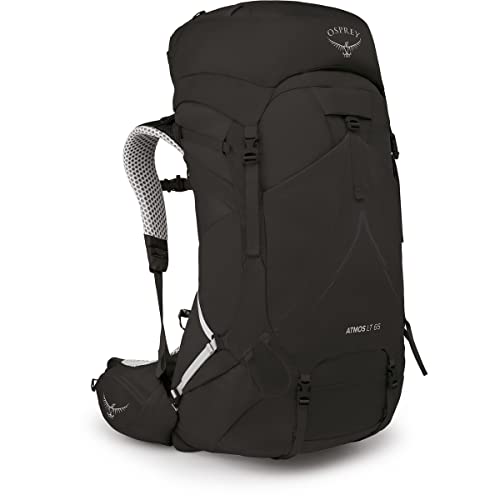
The Atmos AG LT answers a simple question: can you keep the body-hugging comfort of the standard Atmos AG while trimming pounds off the final carry weight. The answer is yes, with some careful pruning. The LT keeps the same mesh-suspended harness, the same wraparound hipbelt, and the same hip-to-shoulder load transfer, then strips back to a cleaner, lighter feature set. For thru-hikers and gram-conscious weekend trekkers, that trade is usually worth taking.
Where the standard Atmos AG included a built-in raincover and Stow-on-the-Go pole attachments, the LT goes more minimalist. You give up a few convenience features, then carry a noticeably lighter pack across multi-week distances. Anyone who has watched their pack weight balloon past 45 pounds will appreciate the breathing room, especially on rolling terrain where every pound compounds across thousands of footsteps.
Where It Helps
- AntiGravity suspension carries over from the standard Atmos, so comfort does not take a back seat.
- Streamlined build keeps pack weight down without sacrificing tors.
- Stripped feature set removes weight you rarely use anyway.
- L-XL torso range covers taller hikers who struggle to find a fit elsewhere.
Some Limits To Know
- Fewer features than the standard Atmos AG means you may need to add accessories like a separate raincover.
- Lighter construction puts a ceiling on maximum carry weight; load it past 40 pounds and you may feel frame flex.
- Premium pricing applies here too, just for fewer bells.
Whose Trail This Belongs On
Thru-hikers, fastpackers, and weight-conscious weekend trekkers carrying 25 to 35 pounds get the best return from the LT treatment.
When A Different Pick Suits Better
Heavier loads and rough terrain are better handled by the standard Osprey Atmos AG 65L Men’s Backpacking Backpack.
The Aura AG 65 is the women’s counterpart to the Atmos AG, sharing the same AntiGravity suspension platform but built around a harness shaped for female anatomy. The shoulder straps are narrower, the sternum strap sits higher, and the hipbelt is contoured to wrap the iliac crest rather than dig straight into it. Those changes may sound minor until you spend a full week on the trail and realize your shoulders are not bruised and your hips are not numb by day four.
Like the men’s Atmos, the Aura uses a tensioned mesh back panel that lifts the pack off your spine and lets air circulate. Stretch side pockets, integrated raincover, and Stow-on-the-Go trekking pole attachment carry over directly. The WM-L sizing fits torsos roughly 19 to 22 inches, covering most adult women carrying gear for one or two. Compared to the unisex Atmos AG LT, the Aura trades some weight savings for a fit engineered around female center-of-gravity.
The Helpful Details
- Women’s-specific harness and hipbelt shape transfers load through the hips without hot spots.
- AntiGravity mesh back panel vents heat across the spine on warm climbs.
- Stretch side pockets stash full-size bottles or fast-access layers without fiddling with straps.
- Stow-on-the-Go trekking pole attachment keeps poles accessible without pack removal.
- Integrated raincover deploys from a built-in pocket when weather turns.
Trade-Offs Worth Knowing
- Heavier than ultralight alternatives, since suspension and padding add their own ounces.
- Premium price point puts the Aura in the same tier as the men’s Atmos AG.
Whose Trail This Belongs On
Female backpackers carrying 30 to 45 pounds on multi-day or weeklong trips get a real fit advantage from the women-specific harness.
A Different Pick Suits Better When
Hikers prioritizing raw weight savings over harness contour should consider the lighter Osprey Atmos AG LT 65L Men’s Backpacking Backpack.
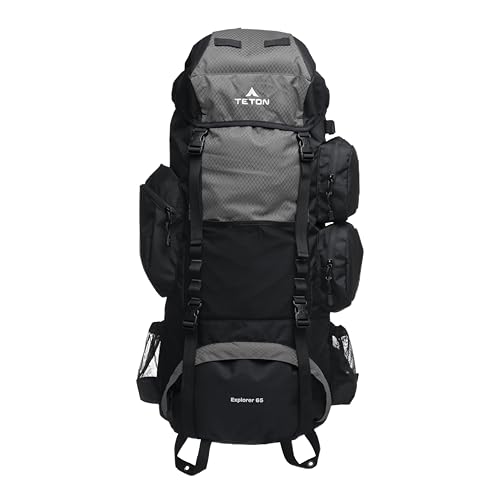
The Teton Explorer is the entry point for people who want a real 65-liter internal-frame pack without paying flagship money. It comes with features most budget packs skip: an integrated raincover stored in its own bottom pocket, an adjustable back panel and harness system that fits a range of torso sizes, and multiple compression straps that cinch the load down tight. For someone stepping up from day hiking into their first real multi-day trip, that combination removes a lot of guesswork.
The trade-off shows up in the suspension: the Explorer uses a more conventional foam-padded back panel rather than a tensioned mesh system. You give up the ventilation advantage of an Osprey AG pack, but for shorter trips, cooler weather, or shaded forest routes, that difference rarely matters. Compared to the Mardingtop covered next, the Explorer focuses on standard torso sizes rather than expandable capacity, and sits in a different price bracket for casual backpackers.
Practical Pluses
- Built-in raincover saves buying a separate cover.
- Adjustable back panel and straps dial the fit across a wide torso range.
- Multiple compression straps stabilize the load when not fully packed.
- Internal frame supports heavier hauls without sagging.
Trade-Offs Worth Knowing
- Conventional back panel runs warmer than mesh-suspended packs on hot climbs.
- Heavier than premium options, noticeable on long mileage.
- Brand recognition and warranty support trail the bigger-name competitors.
Quick Facts
Whose Trail This Belongs On
First-time backpackers, casual weekend campers, and parents outfitting a growing teen get solid value without flagship pricing.
Look Elsewhere When
Hot-climate hikers who prioritize back ventilation should reach for the Osprey Atmos AG 65L Men’s Backpacking Backpack instead.
The Mardingtop 65L+10L earns its place by offering expandable capacity that most packs in this class do not match. The “+10L” refers to a collar extension that lets you boost the total to 75 liters when you need to haul bulky layers, extra food for a group trip, or hunting and camping gear that just will not compress down. When you do not need the extra room, the collar rolls and cinches back into a normal 65-liter silhouette.
It comes with an integrated raincover, an internal frame for load stability, and a design aimed at hunters and campers who carry bulky or awkward items. Compared to the Teton Explorer, the Mardingtop leans more toward capacity than fit refinement; compared to the Kelty Coyote covered later, it gives you less adjustability in the harness but more in the bag itself. If your trips tend to grow unpredictably, that extra 10 liters can save a second bag.
Why It Works Well
- Collar extension adds 10 liters when gear loads grow beyond a standard weekend.
- Internal frame stabilizes the load across rough terrain and long walks.
- Integrated raincover ships in the pack, no separate purchase needed.
- Storage works well for hunters carrying bulky layers or game bags.
Practical Considerations
- Heavier than standard-capacity packs, since the frame and extension hardware add weight.
- Harness adjustability is less refined than premium alternatives, so fit tuning takes patience.
- Brand is less familiar than Osprey or Kelty, and warranty support reflects that.
Whose Trail This Belongs On
Hunters, group-trip packers, and campers carrying bulky seasonal gear get the most value from the expandable capacity.
Consider Another Pick When
Hikers who want refined harness adjustability for daily comfort should consider the Kelty Coyote 60-105 Liter Internal Frame Backpack.
The Osprey Rook 65 sits just below the Atmos AG in the lineup, keeping Osprey’s build quality and warranty support while using a simpler suspension system. The AirSpeed back panel uses a tensioned mesh-and-foam combination rather than the full AntiGravity wraparound, so you get decent ventilation without the premium airflow of the Atmos. For new backpackers who want Osprey’s reliability without paying for the flagship, the Rook is a sensible middle ground.
It still ships with an integrated raincover and a straightforward feature set that does not overwhelm first-time users. A new injection-molded ladder lock system makes torso adjustment simple, even for someone who has never dialed in a backpack fit before. Compared to the Atmos AG, you give up some ventilation and a bit of feature depth; compared to the budget Teton Explorer, you get better Osprey build quality and a more refined fit system at a slightly higher price.
The Value In It
- AirSpeed suspension provides decent airflow at a lower price than the Atmos AG.
- Ladder lock torso adjustment simplifies fit tuning for new backpackers.
- Integrated raincover protects gear on rainy trips.
- Osprey build quality and warranty support without flagship pricing.
Trade-Offs Worth Knowing
- Less ventilated than the Atmos AG on hot climbs.
- Fewer organization features than the higher-end Osprey packs.
- Heavier than ultralight alternatives from competitors.
Whose Trail This Belongs On
New backpackers who want Osprey build quality and a forgiving fit system without stepping up to flagship pricing.
A Different Pick Suits Better When
Hot-climate hikers should consider the Osprey Atmos AG 65L Men’s Backpacking Backpack for stronger ventilation.
The Kelty Coyote straddles two worlds: a 65-liter mode for normal weekend trips, and a fully expanded mode that scales up to 105 liters when your load demands it. That range is unusual in this category and makes the Coyote a strong match for travelers and expedition-style backpackers who do not know exactly how much space they will need until they start packing. The Fit-Pro adjustment system dials in torso length quickly, and the AMP-Flow ventilated back panel adds real airflow for a pack this size.
The Coyote is hydration compatible, so you can drop in a 3-liter reservoir without retrofitting. The advanced perimeter frame keeps the load stable even when you push toward the upper capacity range. Compared to the Mardingtop 65L+10L, the Kelty gives you more refined fit adjustability and a longer expansion range; compared to the Osprey Atmos AG, you give up some ventilation refinement but gain raw cargo capacity.
Everyday Wins
- Expandable range from 60 to 105 liters handles everything from weekend trips to expedition loads.
- Fit-Pro adjustment system dials torso fit quickly.
- AMP-Flow ventilated back panel adds airflow for a pack this size.
- Hydration compatible for reservoir carry without modification.
- Perimeter frame stabilizes heavy loads across rough terrain.
Trade-Offs Worth Knowing
- Heavier than fixed-capacity packs, especially in expanded mode.
- Bulkier silhouette on day hikes where you are not using full capacity.
Quick Facts
Whose Trail This Belongs On
Expedition backpackers, gear-hauling travelers, and trip planners who do not know their final cargo size get the most value from the adjustable capacity.
Consider A Different Pick When
Lightweight weekend trekkers carrying fixed loads should consider the Osprey Atmos AG LT 65L Men’s Backpacking Backpack instead.
The SKYSPER Anti Theft is not a 65-liter pack and never tries to be. It earns a spot as a companion bag: an 18-liter packable daypack that folds down small enough to live inside your main pack until you need it. Drop camp at a trail junction, pull out the SKYSPER, and head up a side peak with water, snacks, and a layer without hauling the full 65 liters. For summit bids, day hikes from base camp, or quick town runs during a multi-day trip, that flexibility earns real space in your kit.
The “Anti Theft” naming covers three small features: a main compartment zipper lock, an RFID-blocking middle pocket to shield card data from skimmers, and a hidden rear zip pocket against your back for valuables. None of these replace real situational awareness, but they add modest security in busy transit hubs and tourist areas. Compared to every other pack in this roundup, the SKYSPER plays a different role entirely: it complements a 65-liter hauler rather than replacing one.
Noteworthy Benefits
- Packable design stashes inside a larger pack for summit runs and day trips from base camp.
- Main compartment zipper lock adds a small barrier against casual grab-and-go theft.
- RFID-blocking pocket shields card data from skimmers in crowded areas.
- Hidden rear zip pocket sits against your back for valuables in transit.
Trade-Offs Worth Knowing
- Only 18 liters of capacity, so it cannot replace a real hiking pack.
- Lightweight construction is not built for carrying heavy loads across rough terrain.
- Anti-theft features add modest security but should not replace normal precautions.
Whose Trail This Belongs On
Multi-day backpackers who want a packable summit bag for side trips from base camp get a strong utility play.
Look Elsewhere When
Anyone needing a primary backpacking pack should pair this with a true 65-liter hauler like the Osprey Atmos AG 65L Men’s Backpacking Backpack.
Factors To Weigh Before Choosing Your 65-Liter Pack
Suspension And Back Ventilation
The biggest comfort divider among 65-liter packs is the suspension system, specifically how the pack body rides against your back and how much heat that interface lets through. Tensioned mesh designs lift the load away from your spine, so air moves between your back and the pack body; foam-padded systems sit closer to your body but run warmer. On humid climbs or summer desert trips, mesh suspension earns its keep; on cool forest routes, the difference shrinks. Consider where you actually hike most often before paying a premium for ventilation.
Torso Fit And Harness Sizing
A pack that does not match your torso length puts pressure on your shoulders instead of your hips, and no suspension system can fix that. Most 65-liter packs come in S/M and M/L (or similar) sizing, and many add ladder-lock or Fit-Pro adjustment systems to extend the range. Measure your torso from the C7 vertebra (the bony bump at the base of your neck) to the iliac crest (top of your hips) and match it against the manufacturer’s chart before buying. A 20-minute measurement saves weeks of shoulder pain on the trail.
Capacity Versus Weight Trade-Off
More liters usually means more pack weight, even when you do not fill the space. Expandable packs like the Kelty Coyote and Mardingtop 65L+10L scale up for expedition hauls, but their frames and extra fabric add ounces you carry every trip. Stripped-down packs like the Osprey Atmos AG LT trim features and fabric to shave weight, but expect to add accessories like a separate raincover. Match the pack’s empty weight against your typical trip length and load.
Hydration, Rain Protection, And Trekking Pole Carry
Most modern 65-liter packs support hydration reservoirs, and many ship with integrated raincovers stored in their own pockets. If you hike with trekking poles, check for Stow-on-the-Go attachments or compatible loops. These small conveniences decide whether a pack feels modern and considered or dated and frustrating on real trail days. Worth weighing them into your choice even when the specs look similar on paper.
Common Buying Traps And Where The Premium Goes
Where Shoppers Go Wrong
The most common mistake is choosing a pack based on capacity alone and ignoring torso fit, since 65 liters carried on a poorly matched harness feels heavier than 50 liters on a properly fitted pack. Another trap is overpaying for ventilation features you will never use, or underpaying for a budget pack that lacks an integrated raincover when you hike in wet climates. Always match the pack to the trips you actually take, not the most extreme trip you might take someday.
What Separates Premium From Basic
Higher-tier packs spend your money in three places: lighter and stronger fabrics, more refined suspension systems, and better-fitting harnesses built around specific body types. None of that matters on a short, cool-weather hike, but on a 50-mile, weeklong traverse in midsummer heat, the difference between a mesh-suspended harness and a foam pad becomes the difference between finishing strong and finishing cooked. If your trips rarely push past weekend length, a mid-tier pack like the Osprey Rook gives you most of the comfort at a much friendlier price.
Frequently Asked Questions
How Much Can A 65-Liter Backpack Realistically Hold?
A 65-liter pack typically holds enough for a weeklong backpacking trip in three-season conditions, including a tent, sleeping bag, pad, cooking system, food, clothing layers, and rain gear. The exact amount depends on how efficiently you compress your gear and how cold the conditions get. Winter trips with heavier sleeping bags, insulated jackets, and snowshoes often push toward the upper limit of what 65 liters can comfortably carry.
Are Women’s-Specific Backpacks Worth The Investment?
Women’s-specific packs use harnesses shaped around narrower shoulders, a higher sternum strap position, and hipbelts contoured for wider iliac crests. For many hikers, that shaping translates to noticeably less shoulder pressure and better load transfer to the hips over long miles. The fit advantage shows up most on multi-day trips where small pressure points compound into real fatigue.
Is An Integrated Raincover Better Than A Separate One?
Integrated raincovers deploy faster because they live in the pack and never get left behind. They also tend to fit the pack’s exact dimensions, so coverage is tighter than aftermarket covers. A separate aftermarket cover usually costs less, fits multiple packs, and can be replaced independently if it wears out. The integrated option wins on convenience; the separate option wins on flexibility and replacement cost.
How Do I Know If I Need An Expandable Pack?
Expandable capacity makes sense when your trip loads vary widely, such as winter trips with extra insulation or family trips where you are hauling group gear. A fixed-capacity pack works better when you already know your typical load size and want to avoid carrying extra fabric and frame weight on every trip. Think about your last three trips: did each load sit close to the same size, or did it vary by 10 liters or more?
Can A Packable Daypack Replace A Real Hiking Pack?
No. Packable daypacks like the SKYSPER 18L handle summit runs, town trips, and light day hikes from base camp, but they cannot carry the weight, distribute load, or manage ventilation that a real 65-liter pack provides. Treat a packable daypack as a useful companion to your main pack rather than a replacement for one.
Closing Thoughts
The right 65-liter pack comes down to your torso, your typical load, and the climate you hike in most often. Match those three honestly and the choice gets much simpler: ventilation and harness refinement for warm multi-day trips, expandable capacity for unpredictable loads, lightweight build for thru-hikers counting every ounce, and a packable companion for summit bids from base camp. Whatever you pick, a properly fitted harness matters more than any single feature on the spec sheet, so take the time to measure and adjust before you head out.